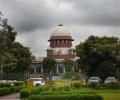
A five-judge Constitution bench of the Supreme Court is scheduled to consider the Presidential reference on whether timelines could be imposed by judicial orders for the exercise of discretion by the President while dealing with bills passed by state assemblies.

The National Company Law Tribunal (NCLT) on Wednesday deferred the hearing on Vedanta Ltd's proposed demerger to September 17, as market regulator Sebi is yet to complete the scrutiny of the proposal, while the central government has raised certain objections. The matter, which was part-heard earlier, had been adjourned to August 20.

The 2025 Redefined Thar takes that phenomenal, rugged capability and wraps it in a shell of genuine usability. Rajesh Karkera/Rediff simply cannot stop raving about the offroad civilised beast.

A Supreme Court order relocating an elephant to a care facility in Vantara has sparked public outrage in Maharashtra by putting the state government in a difficult position over issues of animal welfare and public sentiment.
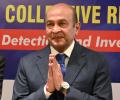
Lok Sabha Speaker Om Birla admitted a notice for the removal of High Court judge Justice Yashwant Varma and constituted a three-member committee to probe charges against him.
The Supreme Court has ordered the release of Sukhdev Yadav, convicted in the 2002 Nitish Katara murder case, citing completion of his 20-year sentence. The court questioned the Sentence Review Board's rejection of his remission plea.

The Supreme Court refused to stay a provision barring the declaration of tribal lands as waqf properties, upholding key provisions of the Amended Waqf Act.

The Supreme Court has upheld the deletion of the 'waqf by user' provision in the amended waqf law, stating it is not arbitrary and addresses potential misuse.

The Supreme Court has put on hold several key provisions of the Waqf (Amendment) Act, 2025, including the clause that only those practicing Islam for the last five years can dedicate a property as Waqf. The court also addressed the powers of collectors and non-Muslim participation in Waqf Boards.

The CBI will seek police remand of eight Jammu and Kashmir Police personnel arrested for allegedly inflicting brutal custodial torture on a fellow constable in 2023. The case involves allegations of severe abuse and mutilation, leading to a Supreme Court-ordered investigation.

The Supreme Court has ruled that motor vehicle tax is not applicable if a vehicle is not used or kept for use in a 'public place'. The ruling came on an appeal challenging a judgement of the Andhra Pradesh High Court.

Maharashtra minister Prakash Abitkar said efforts are underway to bring back elephant Mahadevi from a rescue center in Gujarat. The elephant was relocated following a court order due to health concerns. Local leaders are protesting the relocation and seeking her return.

'He is the same man who has won honours for the country across the world.'

Left-arm spinner Keshav Maharaj produced a career-best 5-33 to dismantle Australia and bowl South Africa to an emphatic 98-run victory in the opening one day international in Cairns on Tuesday.

The GenZ violence that engulfed Nepal is not only against nepo-babies -- its anger is broader and riddled with contradictions, making it difficult for interim PM Sushila Karki, points out Aditi Phadnis.

The Supreme Court has criticized the selective publication of a preliminary report on the Air India crash, calling it 'unfortunate and irresponsible'. The court raised concerns about privacy, dignity of victims' families, and the potential for biased narratives.
A bench comprising Chief Justice B R Gavai and Justices Augustine George Masih and AS Chandurkar also directed that the offending video be immediately taken down and restrained the YouTube channel from republishing it or similar content.

'Today, the State looks at everyone with suspicion.'
The CBI has filed a case against six Jammu and Kashmir police officials for allegedly torturing a fellow constable in custody. The case was registered following a Supreme Court order.
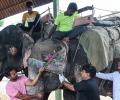
Thousands of people participated in a 'silent march' in Kolhapur on Sunday, demanding that 36-year-old female elephant Mahadevi (also called Madhuri), be brought back from Vantara wildlife rescue, treatment, and rehabilitation centre in Gujarat's Jamnagar district.

The Congress party has accused Union Minister Nitin Gadkari of conflict of interest, alleging his sons' companies have benefited from the government's ethanol blending policy. The BJP has rejected the allegations.

In an unprecedented move, the Supreme Court administration has written to the Centre for vacating the official residence of the Chief Justice of India at Krishna Menon Marg in New Delhi, noting that the current occupant ex-CJI D Y Chandrachud has stayed beyond the permissible period.
In a full court meeting, the top court judges decided to disclose their assets and the data will be uploaded on the SC website.

The bench said, given the pressing nature of the crisis, particularly in cities like Kota, Jaipur, Sikar, Vishakhapatnam, Hyderabad, and Delhi, where students migrate in large numbers, immediate interim safeguards are the call of the day.
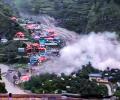
'There is a clear relationship between the Char Dham road widening and these landslides.' 'The situation has further worsened with the massive influx of tourists whose number are running into several lakhs per month.' 'No parameters have been laid down to control tourist inflow and the result is that the Char Dham yatra has seen a sharp escalation in accidents and loss of lives.'
'Non-BJP state governments and their leaders, navigating today's political landscape, know well they have no clue what awaits around the corner.' 'The chances of charges pressed and oneself getting parked in custody play out on an uneven playing field,' points out Shyam G Menon.

The committee said the Uttar Pradesh government did not file appeals against the high court's November 8, 2023 order and instead, an impleadment application was filed in the pending plea before the top court.

President Droupadi Murmu has exercised powers under Article 143(1) used in rarity to know from the Supreme Court whether timelines could be imposed by judicial orders for exercise of discretion by President while dealing with the bills passed by state assemblies.

The court said there is nothing on record to suggest that since 2023, Purkayastha was ever called to join the investigations.

'The protection of secrecy and anonymity gets lost with this linking.'
'This type of comprehensive legislation has never been introduced before in Parliament's history.' 'A bill that simultaneously affects ministers, chief ministers, and the prime minister represents completely uncharted Constitutional territory.' 'Throughout our nation's legislative history, the established policy has consistently held that public office holders should face punishment only after receiving conviction from a competent court of law. Without this safeguard, we risk systematic destabilisation, and our federal structure would face complete collapse.' 'Any central government could potentially deploy this legislation against state governments they oppose politically. This represents the most frightening prospect and dangerous possibility that these bills create.'
'As a result of delays, the desired reliefs are not coming for taxpayers.'
The Supreme Court has begun hearing petitions challenging the Election Commission's decision to conduct a special intensive revision exercise in Bihar ahead of elections, raising concerns about voter exclusion.
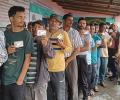
The Election Commission has assured the Supreme Court that no voter's name will be deleted from the draft electoral roll in Bihar without prior notice and a fair hearing. The EC also clarified that it is not required to share separate lists of those not included in the draft rolls.

The Supreme Court dismissed Allahabad High Court judge Yashwant Varma's plea seeking invalidation of a report that found him guilty of misconduct in the cash discovery row.
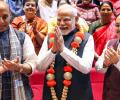
In his first address to National Democratic Alliance MPs in over a year, Prime Minister Narendra Modi on Tuesday emphasised its collective identity as a natural and organic alliance, asserting that its journey since its foundation in 1998 is dotted with successes and has many more achievements in store.

The Jane Street-Sebi saga is more than a legal dispute -- it's a litmus test for India's ambitions as a global financial hub.
The Supreme Court of India has sought responses from the Centre and others on a petition challenging the constitutional validity of certain provisions of the Waqf Act, 1995. The petition argues that the Act gives undue favor to waqf properties and deprives non-Muslims of their property rights. The court has tagged the petition with pending petitions that raise similar issues.

The Election Commission of India (ECI) asserts that major political parties participated in the Special Intensive Revision (SIR) of electoral rolls, deploying booth level agents despite opposing the exercise in the Supreme Court. The ECI defends its authority to conduct the revision to maintain the integrity of elections.
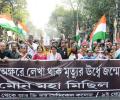
A year after a young woman doctor was raped and murdered in Kolkata, her parents express their disappointment with the investigation and their continued pursuit of justice.
